
Every so often, a story surfaces that reminds us why humour matters far beyond punchlines or applause. One such story came to me from my friend Dr Eliza Kaczynska-Nay, about two men: one haunted by history, the other armed with laughter.
During the filming of Schindler’s List, Steven Spielberg lived each day surrounded by history’s deepest sorrow. On location in Kraków, the ghosts of the Holocaust lingered between every take.
“I felt like I was living inside the tragedy,” he later said. “The line between past and present began to blur.”
And then, the phone would ring.
“Helloooooo! This is your daily dose of insanity!”
Came the unmistakable voice of Robin Williams, a man whose laughter could reach into the darkest corners and pull you back into the light.
Vanity Fair captured the story beautifully Here.

Robin didn’t ask how Spielberg was. He already knew. Instead, he launched into improvised stand-up routines that were part healing and part hysteria. Sometimes it was penguins running a deli in Poland; sometimes it was a dozen absurd characters all vying to be Spielberg’s assistant.
At the film’s 25th-anniversary event, Spielberg revealed that Williams called him once a week during production and would
“do fifteen minutes of stand-up on the phone” before hanging up on the biggest laugh. “It was just Robin being Robin,” Spielberg said. “He made me laugh hysterically every time.”
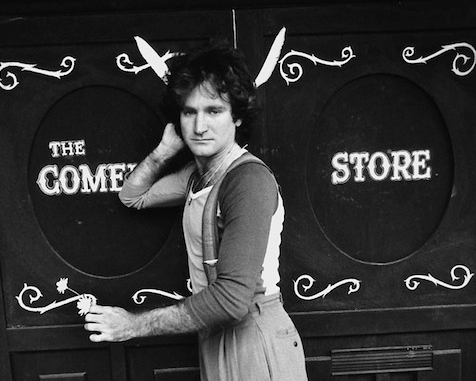
I had the privilege of working with Robin at the Comedy Store.
What a comedy mind. He could sense the state of a room within seconds and change it completely with a single line. That’s Humourology in action: reading the emotional weather and resetting it with warmth, wit and connection.
We often talk about humour as a “nice-to-have”. The Spielberg and Williams story shows it’s essential. When people are under pressure, laughter is a psychological reset. It loosens fear, widens perspective and reminds us we’re not alone. Spielberg has said those calls helped him manage the emotional toll of filming. One man was haunted by history; the other armed with laughter.
It also underlines something leaders too often forget: serious work still needs light. Teams tackling hard, meaningful problems need moments of shared levity to keep them human. Laughter doesn’t trivialise the task; it sustains the people doing it.
If you’ve ever helped someone through grief or stress, you’ll know that funny and kind can coexist. Laughter is not the opposite of empathy. It is empathy’s most uplifting expression.
Three Takeaways for Leaders (and Friends)
- Create your “rescue rituals”. 📋
Have a plan for pressure. Whether it’s a short check-in, a five-minute reset at the end of a heavy meeting or a spontaneous moment of laughter, treat it as a serious part of resilience. - Borrow Robin’s radar. 👀
Notice who’s gone quiet. Reach out before it’s asked for. A small, well-timed laugh can say, “I see you,” without a single word of advice. - Make light, don’t make light of. 🤗
Humour should lift, not diminish. The best laughter helps us rise above, not turn on one another.
As Dr Phil Hammond said on The Humourology Podcast,
“Laughter is medicine, and one of the few that tastes good.”
You can listen to our full conversation here.

Eliza’s story reminds us that friendship itself can be a form of leadership. In this tale, one man wielded a camera, the other wielded comedy. Both changed the emotional temperature of the world: one frame, one laugh, one act of kindness at a time.
See you next Tuesday.
Warmest,
Paul x


